
That is a question asked at our recent Chillicothe Society Meeting. While I had read the poem Lepanto in the book of that title, edited by Dale Ahlquist, I had forgotten the explanation related by Dale in his discussion of the poem. Here it is:
The man who was the inspiration for Chesterton's most famous fictional character was also the inspiration for Chesterton's most famous poem. That man was Father John O'Connor, the priest who was the model for Father Brown. In the spring of 1911, both Chesterton and Father O'Connor participated in a debate about war. The two friends were apparently on the same side in the debate. Chesterton argued that all wars are religious wars, and Father O'Connor gave a description of the battle of Lepanto that Chesterton said was "magnificent". It obviously stirred his fertile imagination. Father O'Connor later recalled;
I told of how Phillip the Second of Spain had been assembling his Armada to invade England and could only spare two ships to face the hundred galleys of the Porte, and how Don John of Austria, the only commander under whom Genoa would agree with Venice, burst the battle-line on a sinking ship after fighting through all the hours of daylight. And the story of the Pope's prayer all that day and his vision of the crisis of the action at three in the afternoon, with his vision of the victory of the Angelus. Thus, I take it, came Chesterton to write the imcomparable ballad of Lepanto (Father Brown on Chesterton, p. 85)
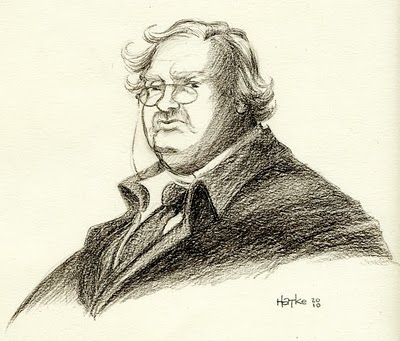
 There were four of us at this month's meeting. As advertised, we listened to Christopher Check's "Lepanto: The Battle and the Poem." The talk is almost 75 minutes long, ending with a stirring recitation of Chesterton's poem Lepanto. Some of the folks took notes during what could easily be called a Mediterranean Catholic history lesson.


