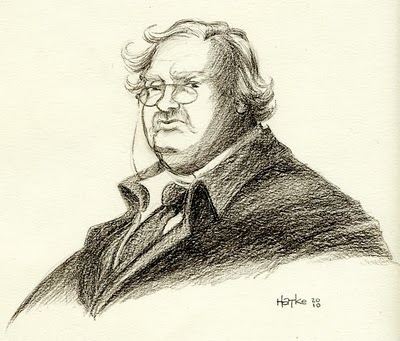
 Here's a suggestion on how to get started in supporting the idea of Distributism. It's from The Distributist Review.
Showing posts with label Distributism. Show all posts
Showing posts with label Distributism. Show all posts
Wednesday, November 17, 2010
Distributism, Where to Begin?
Here's a suggestion on how to get started in supporting the idea of Distributism. It's from The Distributist Review.

Thursday, September 16, 2010
September Meeting
 Well, we had our first meeting in the St. Peter Parish library, The Holy Family Library. Several folks attended, which was a nice change from the last couple of meetings which were held in our previous venue. We read a couple of essays aloud from What's Wrong With The World and then commented on them. I fielded a question on Distributism and felt fairly comfortable with my answer.
We agreed to read and discuss Lepanto at our next (October) meeting. We're going to use Christopher Check's "Lepanto: The Battle and the Poem" CD as a major part of the meeting.
Finally, the folks who manage the library have asked if we could put together a display having G.K. Chesterton featured as the "Author of the Month" and also put a notice about it in the Parish Bulletin.
Sunday, July 18, 2010
A Change of Opinions
 Lord Kitchener
The other matter is much more important. Though the reverse of vivacious, Kitchener was very vital; and he had one unique mark of vitality—that he had not stopped growing. “An oak should not be transplanted at sixty,” said the great orator Grattan when he was transferred from the Parliament of Dublin to the Parliament of Westminster. Kitchener was sixty-four when he turned his face westward to the problem of his own country. There clung to him already all the traditional attributes of the oak—its toughness, its angularity, its closeness of grain and ruggedness of outline—when he was uprooted from the Arabian sands and replanted in the remote western island. Yet the oak not only grew green again and put forth new leaves; it was almost as if, as in a legend, it could put forth a new kind of leaves. Kitchener, with all his taciturnity, really began to put forth a new order of ideas. If a change of opinions is unusual in an elderly man, it is almost unknown in an elderly military man. If the hardening of time was felt even by the poetic and emotional Grattan, it would not have been strange if the hardening had been quite hopeless in the rigid and reticent Kitchener. Yet it was not hopeless; and the fact became the spring of much of the national hope. The grizzled martinet from India and Egypt showed a certain power which is in nearly all great men, but of which St. Paul has become the traditional type—the power of being a great convert as well as a great crusader. It is the real power of re-forming an opinion, which is the very opposite of that mere formlessness which we call fickleness. Nor is the comparison to such an example as St. Paul altogether historically disproportionate; for the point upon which this very typical Englishman changed his mind was a point which is now the pivot of the whole future and perhaps of the very existence of Christendom. For many such Englishmen it might almost be called the discovery of Christendom. It can be called with greater precision, and indeed with almost complete precision, the discovery of Russia.
I guess I consider myself "an elderly military man." I joined the Air Force when I was 17, right out of high school. I served for 20 years. I've been "retired" for 28 years. That is, I retired from the Air Force in 1982. While I've held quite a few jobs since 1962, I think of myself as "retired Air Force", not retired from Battelle, Northrup Grumman, Lockheed Martin, or NewPage, my last place of full time employment. No doubt that is because whatever I am today was pretty much formed by my 20 years immersion in the culture of the Air Force.
What's the point? Well, I guess there are several. First, I think the quote (in red above) is quite true, certainly it is for me. Next, every time I've seen this quotation it is referenced back to Utopia of Usurers. I recently read Utopia of Usurers; it's not in there. As the picture at the top of this post implies, the quotation is from Chesterton's book Lord Kitchener. My best guess on how this happened is that whoever made the first reference might have been using Volume V of the Collected Works. The standard reference says pg. 396, of Volume V, CW. And the quotation does, in fact, appear on page 396, but it's in Lord Kitchener. Utopia of Usurers starts on page 399. Who cares? Probably no one, unless you're reading Utopia of Usurers waiting to read the quote!
Finally, Chesterton says a change of opinion is almost unknown in an elderly military man. I don't think I've changed my opinions about much in the last 28 years, but I have about laissez-faire Capitalism. And that change of opinions was caused by the writings of Chesterton, Belloc and all the other Distributists I've been introduced to by the members of the American Chesterton Society.
Sunday, July 4, 2010
Material Success, Something to Think About
Material Success
The American businessman was at the pier of a small coastal Mexican village when a small boat with just one fisherman docked. Inside the small boat were several large yellowfin tuna. The American complimented the Mexican on the quality of his fish and asked how long it took to catch them.
The Mexican replied only a little while. The American then asked why didn't he stay out longer and catch more fish?
The Mexican said he had enough to support his family's immediate needs. The American then asked, "But what do you do with the rest of your time?"
The Mexican fisherman said, "I sleep late, fish a little, play with my children, take siesta with my wife, Maria, stroll into the village each evening where I sip wine and play guitar with my amigos, I have a full and busy life, señor."
The American scoffed, "I am a Harvard MBA and could help you. You should spend more time fishing and with the proceeds buy a bigger boat with the proceeds from the bigger boat you could buy several boats, eventually you would have a fleet of fishing boats. Instead of selling your catch to a middleman you would sell directly to the processor, eventually opening your own cannery. You would control the product, processing and distribution.
"You would need to leave this small coastal fishing village and move to Mexico City, then LA and eventually NYC where you will run your expanding enterprise."
The Mexican fisherman asked, "But señor, how long will this all take?" To which the American replied, "15-20 years."
"But what then, señor?"
The American laughed and said that's the best part. When the time is right you would announce an IPO and sell your company stock to the public and become very rich, you would make millions.
"Millions, señor? Then what?"
The American said, "Then you would retire. Move to a small coastal fishing village where you would sleep late, fish a little, play with your kids, take siesta with your wife, stroll to the village in the evenings where you could sip wine and play your guitar with your amigos."
-- Anonymous
Sunday, May 2, 2010
Distributism and "Just Price"
I've been reading several books by Hilaire Belloc, who was one of the main proponents of Distributism. He mentions "just price" several times, but I've been unable to figure out exactly what that means to a Distributist. So... I asked one of the authors at The Distributist Review, Richard Aleman, for some help. Here's what he said:
Dear Bob,
You are most welcome. Yes, regarding the just price I recommend reading Dr Peter Chojnowski's article on the School of Salamanca. http://drchojnowski.blogspot.com/
Eric Gill described it most succinctly as,
1. A just price (i.e. price reckoned in terms of labour costs)...[W]hat we want is just price, i.e. price fixed by maker.
The idea was to create a production outlet (or retail/manufacturer combo) that would sell flexibly with the smallest profit margin, competing via the distinctive creations of the producer (in Gill's case, artist or craftsman). This would, as much as possible, elminate middlemen and price wars as every product would be an original work based on the unique creativity of the small business owner.
This is still the case in small shops in Europe. Take bakeries for example. They measure how ingredient and labor costs, bake on premises, and sell directly to the consumer. They never undersell competitors or have a need to widen profit margins as they stand (or fall) on the quality of their unique, various products.
I can also recommend Msgr. John A. Ryan's book "The Living Wage" which you may normally find on ebay or for free on archive.org (PDF). http://www.archive.org/details/livingwage00ryanuoft
Also, if you have not read them, I recommend two more books by Belloc: Economics for Helen and the book Usury. In this last Belloc defines productive property and lending alternatives without the use of token interest.
Keep in touch!
Pax Christi,
Richard
PS: Let me know when you are ready to study the guilds. I will email you some PDFs by Arthur Penty.
Tuesday, January 26, 2010
The New Issue of Gilbert Has Arrived
 Here's the latest Gilbert Magazine. It arrived on Monday, which is my Barbershop singing night, so I only had time to take a picture of the cover. Hopefully I'll get to read it tonight.
By the way, Uncommonsense Podcast #17 is out and available on the ACS web site Blog. In the Podcast Nancy interviews Richard Aleman, President of The Society for Distributism.
Tuesday, January 5, 2010
Dale Ahlquist on Chesterton's view of Distributism

Within the last month or so I became Facebook Friends with Richard Aleman. Richard is the president of the Society for Distributism. I now get a lot of information on Distributism via Facebook. Here is an article by Dale Ahlquist (President of the American Chesterton Society) on Chesterton's views and thoughts about Distributism. The article appears as a Chapter in the book Beyond Capitalism and Socialism published by IHS Press.
Thursday, November 19, 2009
November 18th Meeting
 Well, another successful meeting. It's always a success when someone joins me for the meeting! In the picture above, it's me, Jim Maimone, and Tim Binkley. Andrew Thurston was gracious enough to take the picture. While Andrew has to work during the meetings, he is a member of the Chillicothe Chesterton Society, so maybe I'll never attend a meeting by myself, at least as long as Andrew continues to work at Schlegel's.
Jim Maimone attended his first meeting last night. When I asked Jim how he found out about the meeting, he said he had read about it in St. Peter's church bulletin. The notice in the bulletin was quite old, but Jim had saved it and finally had the opportunity to join us. I'll be asking St. Peter's to run the notice again. I may get yet another member!
We talked about Distributism. All of us are new to the concept so we've decided it will also be the subject of our December meeting. We'd like to know more about it. We've got lots of reading to do.
Since both Jim and Tim are new to Chesterton, I showed them some links we have on this blog. Using one of those links (YouTube) we listened to one of the few recordings of Chesterton. We all enjoyed it. Chesterton's self deprecating humor is refreshing.
And, finally, the big announcement. See the post below. Hilare Belloc will be visiting Chillicothe, Ohio in March of 2010.
Sunday, November 15, 2009
Exciting Announcement Due at Wednesday's Meeting

What is it? Come to the next meeting on Wednesday at 7 p.m., November 18th at Schlegel's and find out! As usual we'll be talking about everything and, eventually, Distributism. The discussion will not be too deep, because I'm just learning about Distributism. I'll have a copy of Chesterton's The Outline of Sanity, and Belloc's The Servile State available for review. These two books were recommended to me by the President of the Society for Distributism. I'll also have my laptop and we'll take advantage of Schlegel's Wi-Fi so we can check out the sites providing information on Distributism.
Here's something else we might discuss. It's a quote from Chesterton.
Here's something else we might discuss. It's a quote from Chesterton.
"The free man owns himself. He can damage himself with either eating or drinking; he can ruin himself with gambling. If he does he is certainly a damn fool, and he might possibly be a damned soul; but if he may not, he is not a free man any more than a dog." - Broadcast talk 6-11-35Hmm! Was my recent vote against casinos consistent with Chestertonian thinking? Based on the above quote, I guess it wasn't.
Tuesday, October 27, 2009
Distributism, Chesterton's "The Outline of Sanity" is a Place to Start
 At the October meeting of the Chillicothe Chesterton Society we, both of us, decided we'd talk about Distributism at the November meeting. So I asked Richard Aleman, a Facebook Friend and the president of The Society for Distributism, to recommend a book to get us started. He and Sean Dailey recommended Chesterton's "What's Wrong With the World" and "The Outline of Sanity". They also recommended Hilare Belloc's "The Servile State". I've got the first two books and will have to order Belloc's. There are also a few blogs and web sites that have a lot of information. In fact I found it overwhelming, so I'm going to concentrate on the first two books as I get started learning about Distributism.
Subscribe to:
Posts (Atom)


